

Productions
Carpet Edition relies on an exclusive production network that combines traditional manual techniques with mechanical processes. Our production methods reflect a continuous dialogue between the ancient art of weaving and technological innovation, offering exceptional creations capable of satisfying every need and style of contemporary interior design.
Artisanal production
Artisanal production is based on the experience and manual precision of the weavers. The use of traditional techniques allows for careful attention to every single phase of the production process, from yarn processing to the final finishes. This approach guarantees rigorous control over the quality of the product.
Hand woven
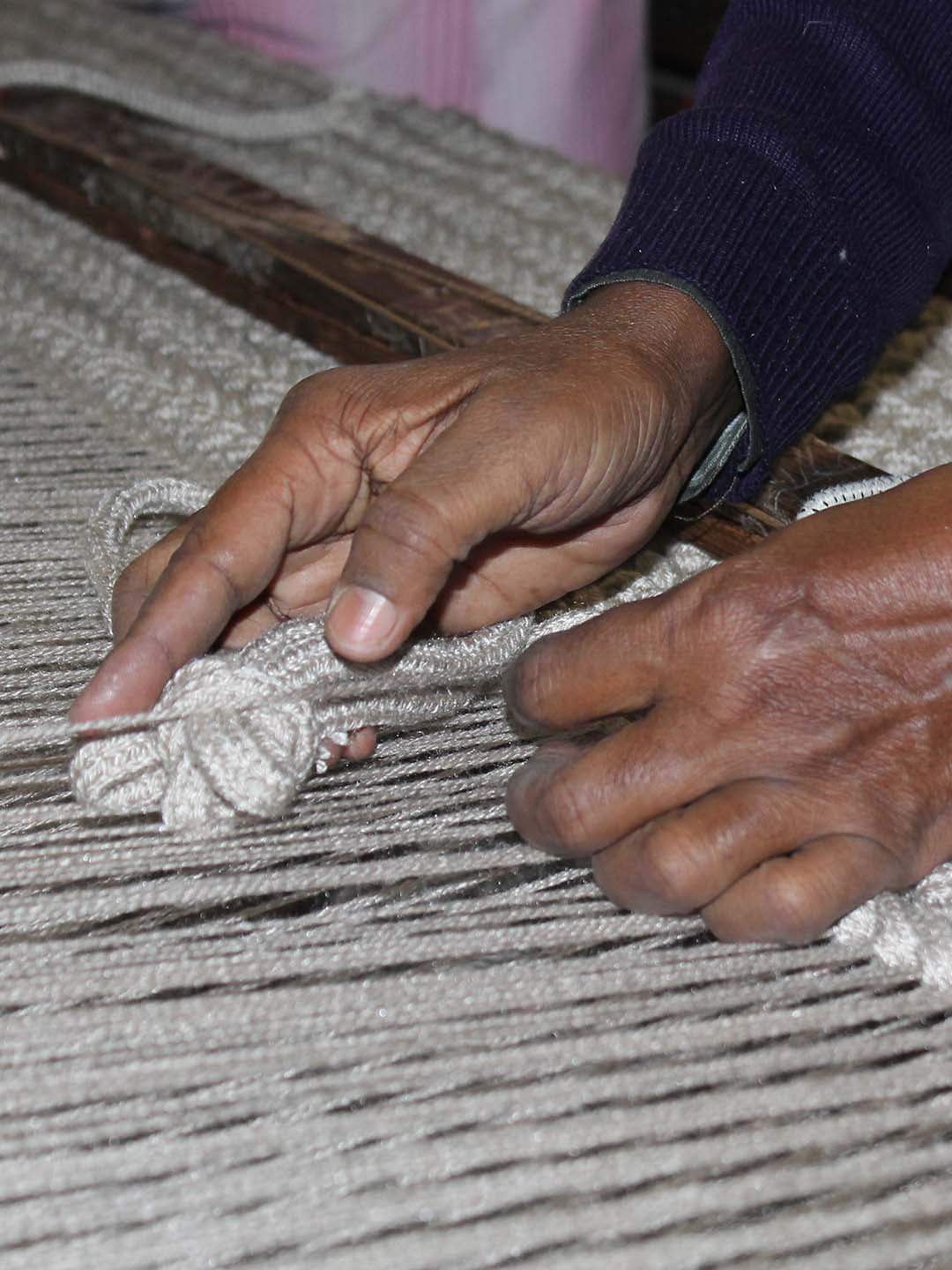
Production technique in which the looms are operated by experienced weavers without the use of any energy source. The loom can be both vertical (Panja) and horizontal and sunken (Pitloom). With this method the threads are braided through a pin and fixed by a large comb that beats and compacts them until you get flat, no-pile carpets. One of the oldest hand-weaving techniques is sumak weaving, in which the weft wraps the warp in a continuous way, in order to create its typical braided decoration.
Hand tufted
A great alternative to fine hand-knotted carpets, hand tufted ones retain all the characteristics of a handcrafted product. The production begins by placing the design of the rug on a vertical canvas where the yarn is inserted through a manual or electric compressed air textile gun. At the end of this phase the carpet is removed from the frame that held the canvas and, after being burned and washed, is finished with a cotton fabric glued on the back; the production process ends with the removal of excess fleece fibers and the subsequent finishing of the carpet. Realized with a variety of materials, hand tufting offers for an unlimited choice of designs, shapes and colors.
Hand loom or loom knotted
The manufacturing process is carried out with a frame that intertwines the weft and the warp. The warp is the series of threads that is mounted directly on the loom during the preparatory phase and defines the width of the carpet, while the weft consists of a single thread that is passed perpendicular to the warp, creating the braid and the pile. A fundamental element of the loom are the “heddles” which allow the warp threads to rise in order to facilitate the passage of the shuttle on which the warp threads are wrapped. A traditional carpet produced with this technique allows for a reduction in processing times compared to manual knotting.
Hand knotted
Ancient workmanship that is passed down from generation to generation. Before starting the knotting an artist draws and colors the motif in 1:1 scale on graph paper. Each square represents a knot. Sitting in front of a vertical frame, the weavers will execute tens of thousands of knots: the higher the number of knots, the higher the quality of the rug and the precision of the design. After the knotting is completed, the carpet will be washed several times to remove the excess fiber and make it shinier and softer; it will then be dried in sunlight. The time required to complete these operations, and consequently the overall production time, may be affected by unfavourable climatic factors, typical of monsoon areas.
Mechanical production
Mechanical production relies on cutting-edge technology to ensure maximum precision and manufacturing efficiency. The use of advanced looms allows for the creation of complex designs and uniform structures, ensuring consistent quality standards and long-lasting durability
Mechanical tufted
The production is entrusted to a latest generation robot that works with maximum precision and speed while a series of wire detection systems minimizes the stops and the repairs. The robot can move in any angle and direction, allowing full customization in shape, design and color. All design work, including vectorization, is performed in a graphical plug-in.
Mechanical woven
This technique allows the production of flat woven rugs among which the best known are those with Jacquard weaving. The new machines are equipped with hundreds of spindles that speed up weaving. A computer controls every detail of the process, thus minimizing the possibility of error.